Smart Water Box Reviews (2026): A DIY Atmospheric Water Generator, Examined
Disclosure: this review contains affiliate links. If you buy through them we may earn a commission at no extra cost to you. We are not the author or seller of this product, we received no sample and no payment from them, and this relationship does not change what is written below.
Smart Water Box is marketed around a striking promise: pull drinking water out of the air in your own home. Before anyone spends money on it, two questions matter more than anything in the sales video. Is the underlying technology real, and what exactly does the buyer receive? The answers are, respectively, yes and rather less than most viewers assume.
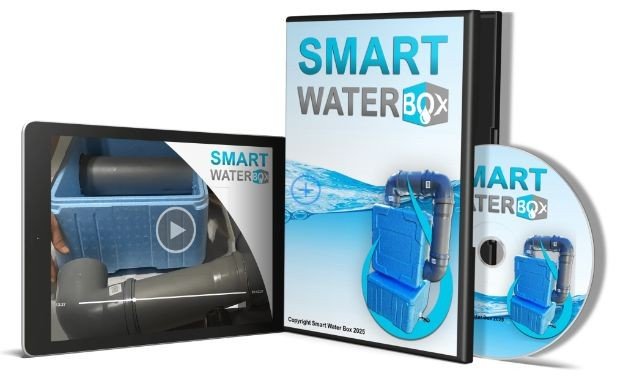
What is delivered is digital: the guide, the video walkthroughs and the blueprints. The unit in the artwork is what you build yourself.
Why household water backup became a mainstream concern
Interest in home water independence is no longer confined to off-grid enthusiasts. Ageing distribution pipes, drought pressure on supply in parts of the country, contamination events involving lead or PFAS compounds, and storms that knock out service for days have all pushed ordinary households to think about a backup. Atmospheric water generation sits at the accessible end of that conversation, and Smart Water Box is the do-it-yourself entry point to it.
The science: how water is pulled out of air
The mechanism is not speculative. Air holds water vapour, and when that air meets a surface colder than its dew point, the vapour condenses into liquid. It is the same reason a cold glass sweats on a humid day, and it is precisely what a household dehumidifier does all summer. An atmospheric water generator adds two things to that: a collection path for the condensate, and filtration that makes the result fit to drink.
Published engineering research on atmospheric water generators reaches a consistent conclusion: the technology works, and its practical output is governed by local climate. Studies benchmarking commercial units across different United States climates find that humidity, temperature and the thermal gradient across the cooling surface are what determine yield, and that the same hardware performs very differently from one region to another. That finding is the single most useful thing a prospective buyer can carry into this decision.
What Smart Water Box actually is
It is a digital product package, delivered instantly after purchase, sold at roughly $39 as a one-time payment and processed by ClickBank. Buyers receive build documentation for assembling an atmospheric water generator from components sold in ordinary hardware and electronics shops. Based on the official material, the package covers:
- Blueprints with dimensions and assembly views
- A parts list described by function, so components can be matched to what is available locally
- Step-by-step build instructions with video walkthroughs
- Siting guidance, covering airflow and humidity, plus powering the unit from a household outlet or a solar setup
- Filtration stages and water testing
- Maintenance intervals and troubleshooting
- Bonus guides bundled with the purchase, including a solar water heating blueprint
Calibrating the headline claim
Marketing material for the product has promoted figures as high as 40 gallons a day. Treat that as the ceiling for a large, fully optimised build running in very humid air, not as what a first build will give you. Independent reports from buyers, and the pattern in the published research, point to a few gallons a day for a typical home build in moderate humidity, with meaningfully more on the Gulf Coast in summer and very little in dry air.
That is not the same as the product being useless. A few gallons a day during a service outage is a very different situation from having none. It is simply a different product from the one the headline number implies.
Realistic output by climate
| Your typical humidity | Where that tends to be | What to expect |
|---|---|---|
| Above about 60% | Gulf Coast, Southeast, coastal Pacific Northwest, Hawaii | The best case for this build. Useful supplemental daily supply in warm months. |
| Roughly 40 to 60% | Mid-Atlantic, Great Lakes, Midwest, mid-South | Modest output that varies with the season. Best treated as emergency backup. |
| Below about 40% | Desert Southwest, Rocky Mountain states, Plains in dry season | Likely too little to be practical. Check local humidity data before buying. |
Seasonality matters as much as region. A unit that performs well in August humidity can underperform badly in the same place in January.
What you get, and what you still have to supply
| Included in the $39 purchase | Your responsibility |
|---|---|
| Blueprints, parts list, step-by-step instructions, video walkthroughs, filtration and maintenance guidance, bonus guides, 60-day ClickBank guarantee | The physical components, commonly estimated at $50 to $200; basic tools; the hours to build it; compliance with local rules; and testing the water before anyone drinks it |
Where the marketing overstates the case
"Up to 40 gallons per day"
An optimal-condition figure presented as though it were typical. See the climate table above for what is realistic.
"Simple device"
The build is achievable for an adult who is comfortable with tools and follows instructions carefully, but it is not trivial, and someone who has never assembled anything of this kind should expect a real learning curve or should enlist help.
"This offer will only appear once"
Standard urgency copy on the checkout. The product remains available at its normal price if you come back later. Nothing is lost by taking a day to think.
Who it suits, and who should skip it
Worth considering if
- You live somewhere humid for much of the year
- You want a supplemental emergency water source alongside stored water
- You enjoy hands-on building projects
- You are curious about the technology and want to learn the principles cheaply
Skip it if
- You expected an appliance to arrive in a box
- You live in a dry climate
- You have no interest in sourcing parts or assembling equipment
- You are counting on it as a sole water supply rather than a supplement
Price, refunds and risk
The guide is a one-time purchase of about $39 on the official page, where the current price and any promotion are shown. ClickBank is the retailer and applies a 60-day money-back guarantee; refunds are requested from ClickBank support with your order details, not from the author. In practice that means you can read the plans, price out the parts for your own area, and decide whether the build is realistic for you before the window closes.

Common questions
Is anything shipped to me?
No. It is a digital download you access immediately after purchase.
What will the whole project cost?
The guide plus materials. Published estimates for the parts run from around $50 to $200, depending on what you already own and on local prices, which still compares favourably with commercial atmospheric water units.
Will it work in winter?
Cold air holds far less moisture, so expect lower yield in cold months and very little in cold, dry conditions.
Is the water drinkable straight from the coil?
No. It needs the filtration stages described in the guide, and the output should be tested. Home water test kits are inexpensive and worth using.
How do I get a refund if I change my mind?
Contact ClickBank customer service within 60 days of purchase with your order details. ClickBank, not the author, processes the refund.